Author: root

  • From Micro Enterprise to World Markets: How PT BAS Manages Its Essential Oil Exports

    From Micro Enterprise to World Markets: How PT BAS Manages Its Essential Oil Exports

    The “micro enterprise” status recorded in the Business Identification Number of PT Bentang Alam Sumatera (PT BAS) sits a little oddly next to the scale of its business as an essential oil exporter. But that gap reveals something interesting: administrative scale does not always reflect the size of the supply chain a company actually manages.

    From Medan, PT BAS combines three foundations at once in running its business: legal compliance, product diversification, and leveraging Indonesia’s position as one of the world’s leading players in patchouli oil. Together, the three help this small company manage both opportunity and risk in a commodity market that constantly rises and falls.

    On the legal side, PT BAS’s business license was issued through the Risk-Based Business Licensing system. Its scope goes far beyond just aromatic-crop plantations and essential oil trading — it also covers agarwood cultivation, wholesale trade in coffee, tea and cocoa, trade in other forestry and agricultural products, waste remediation and management, and research and development in the natural sciences. That broad scope leaves room to develop new business lines still connected to natural resources and agribusiness, with licensing compliance as the baseline that keeps any diversification measured.

    On diversification, PT BAS’s portfolio spans eight commodities: patchouli, Arabica coffee, Robusta coffee, citronella oil, lemongrass, cananga, vanilla and benzoin. The company deliberately avoids relying on a single commodity whose demand rises and falls with the cycles of the global perfume industry. Coffee, kitchen spices and non-timber forest products give it access to very different sets of buyer needs, which helps balance cash flow when the price or demand volume of one commodity shifts — even so, each line still carries its own quality and logistics challenges.

    The third foundation rests on Indonesia’s position in the global patchouli market. Directorate General of Plantations data widely cited by the media shows Indonesia controls around 95% of the global patchouli oil market, with exports of roughly 1,200 to 1,500 tons a year to countries including Switzerland, Britain, Singapore, Spain and France. The price of patchouli oil is determined largely by its patchouli alcohol content and purity level, which means export opportunity is not just about volume but also the ability to maintain consistent quality all the way from farmers’ raw material to the product shipped to buyers.

    Of course, a business model like this is not free of structural challenges. PT BAS’s in-house team of just seven has to maintain a farmer network across three provinces at once, manage collection and logistics, and make sure distillation and packaging run according to buyers’ requirements. Then there are variables outside its control, such as weather, fuel costs for distillation, shifting commodity prices and competition from other exporters. Diversification can reduce concentrated risk, but it does not remove the need for quality control and a stable supply relationship.

    PT BAS’s experience sending patchouli oil exports to London in 2020 stands as evidence that even a micro-scale company can build access to global markets. The key lies in orderly legal compliance, a relevant product portfolio, and farmer partnerships capable of supplying raw material sustainably. As long as its supply network and product quality keep being strengthened, PT BAS has room to grow its role as a link between Sumatran commodities and industrial buyers in the international market.

    Source: Compiled from PT BAS’s Risk-Based Business Licensing (NIB) documents, the PT Bentang Alam Sumatera 2026 profile, Directorate General of Plantations, Ministry of Agriculture data as cited by GoodNewsFromIndonesia.id, and reporting by Tobapos.co.
  • Farmer Partnerships Across Three Provinces: How PT BAS’s Business Model Protects Its Essential Oil Supply Chain

    Farmer Partnerships Across Three Provinces: How PT BAS’s Business Model Protects Its Essential Oil Supply Chain

    Rather than buying up land on a large scale, PT Bentang Alam Sumatera (PT BAS) has chosen a slower path that may prove more durable: building the capacity of partner farmers. Relationships with farmers, field mentoring and land management form the foundation of the company’s entire essential oil supply chain.

    For the Medan-based exporter, that choice means its raw material sources are not concentrated in a single plantation. Supply is instead built through local networks that understand the land, seasons and commodities of their own areas — PT BAS’s partner farmers are spread across Aceh, North Sumatra and West Sumatra, with the commodities and forms of mentoring tailored to each region’s potential. A number of nature-based model management sites have also been developed in North Sumatra and Aceh.

    Two positions within the company reflect how seriously it takes this approach. Mustaqim, S.Hut., M.Si. handles production and partnerships, while M. Irfany serves as agroforestry specialist. That structure shows that partnership at PT BAS is understood not merely as a buy-sell transaction, but as a process of building community capacity while keeping the farming landscape sustainable.

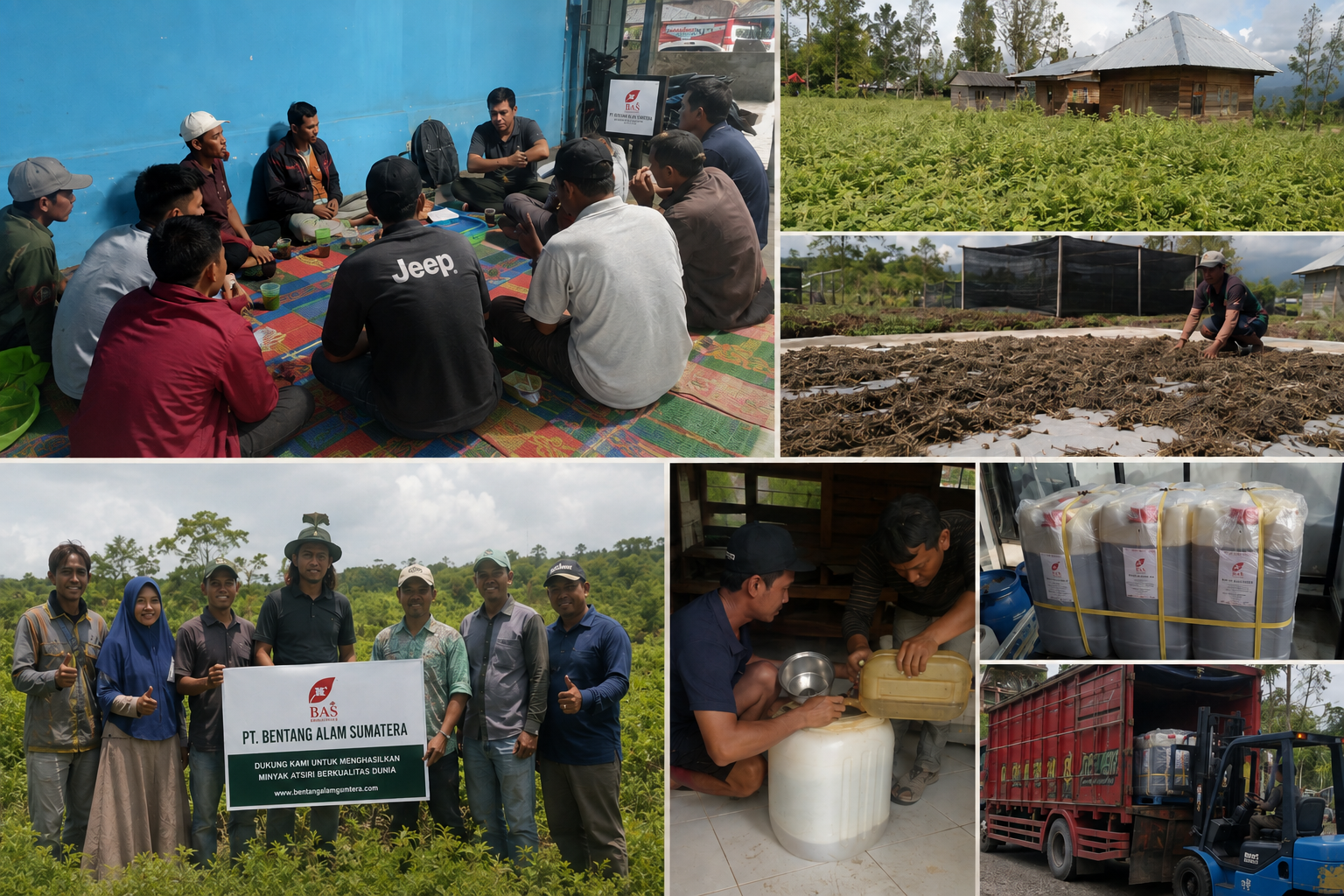
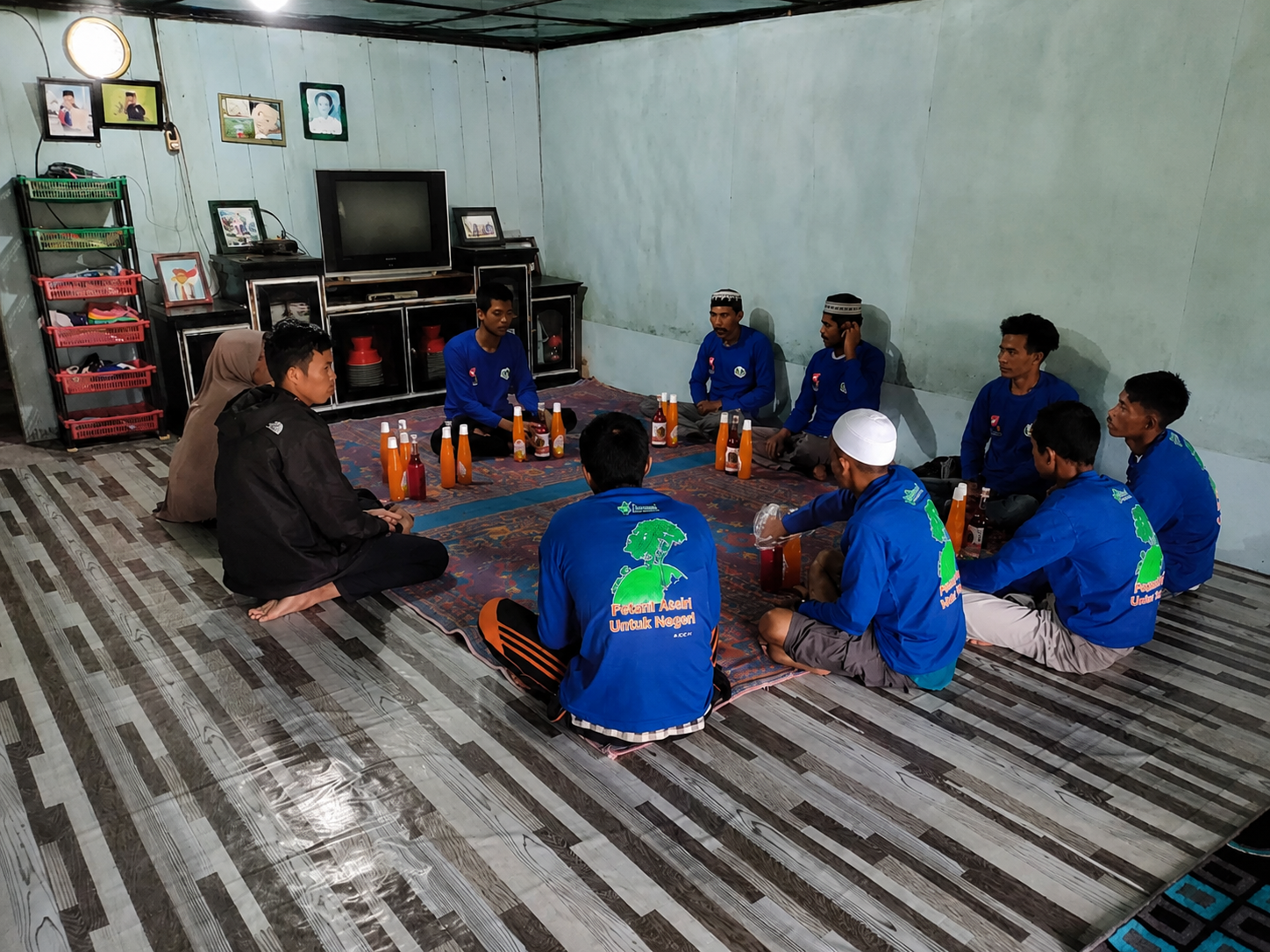
    The process itself is a long one. Company activity records show a chain of mentoring that runs from meetings with patchouli farming groups, to the weighing of dried patchouli stems and leaves, to distillation using simple stills near the farms. The resulting patchouli and citronella oils are then packed into jerry cans and sent to PT BAS’s facilities for further processing — every stage requires tight coordination so raw material keeps meeting quality specifications as it moves from farm to market.

    In terms of land area, the network covers an estimated 80 hectares of patchouli plots spread from Blangkejeren through parts of North Sumatra and West Sumatra, plus around 10 hectares of citronella grass in Blangkejeren. In Besitang, Langkat Regency, farmers have developed an even more diverse planting pattern: ylang-ylang, culinary lemongrass, citronella grass, patchouli, cananga and vanilla all growing within the same area. This kind of mixed cropping pattern is in line with an agroforestry approach, in which a single stretch of land can yield several commodities at once.

    This agroforestry approach is driven by more than just land efficiency. It gives farmers more than one source of income while reducing their dependence on a single commodity. For the essential oil supply chain, both land sustainability and farmers’ income stability determine the long-term availability of raw material.

    But the model is not without its challenges. A network of smallholders scattered across mountainous and rural areas needs consistent mentoring, cultivation training, quality oversight and carefully planned logistics. With an in-house team of only seven, PT BAS depends heavily on farmers’ trust and collaboration with local stakeholders to keep all of it running.

    For patchouli farmers in Blangkejeren, or cananga and vanilla farmers in Besitang, this kind of partnership opens a path to markets that would be difficult to reach alone. In the end, that chain connects small farms in Sumatra to the perfume, cosmetics and food industries, along with other commodity buyers in a far wider market.

    Source: Compiled from the PT Bentang Alam Sumatera 2026 profile, including documentation of partner-farmer mentoring activities in Aceh and North Sumatra.

  • Eight Scents From the Land of Sumatra: The Flagship Products of PT Bentang Alam Sumatera

    Eight Scents From the Land of Sumatra: The Flagship Products of PT Bentang Alam Sumatera

    For PT Bentang Alam Sumatera (PT BAS), essential oils are not just aromatherapy oils sold in small bottles on supermarket shelves. From its base in Medan Selayang, the company actually markets eight commodities at once: essential oils, coffee, kitchen spices, and aromatic resin from the forest — each with its own origin, character and set of buyer requirements.

    Patchouli, or Pogostemon cablin, is the commodity most closely identified with PT BAS. Its leaves and stems are dried, then distilled into what the international market knows as patchouli oil. Its woody, earthy, warm and long-lasting character makes it a favorite as a base note in perfume formulas. The supply chain is built together with farmers in Aceh, North Sumatra and West Sumatra, with a network centered on the Blangkejeren area of Gayo Lues.

    Alongside patchouli, PT BAS also offers Arabica and Robusta coffee from the highlands of Sumatra. Its Arabica coffee carries an aromatic character, lively acidity and balanced body — a profile that can be tailored for roasters or single-origin products, depending on the origin and specifications of each lot. Robusta, meanwhile, brings a bolder taste, fuller body and strong crema, a character usually sought for espresso and commercial coffee blends. Both types are supplied through the same agribusiness network across Aceh, North Sumatra and West Sumatra.

    There are also two types of lemongrass that look similar at a glance but actually come from plant groups with different functions. Citronella grass yields citronella oil through the distillation of Cymbopogon leaves, with a fresh citrus-herbal aroma commonly used in fragrance, home care products and insect-repellent formulas. Culinary lemongrass, or Cymbopogon citratus, is the one more familiar in the kitchen, used as a seasoning for soups and curries and as an ingredient in herbal tea. Within PT BAS’s network, citronella grass is grown in Blangkejeren and Besitang, while culinary lemongrass is centered in Besitang, in Langkat Regency.

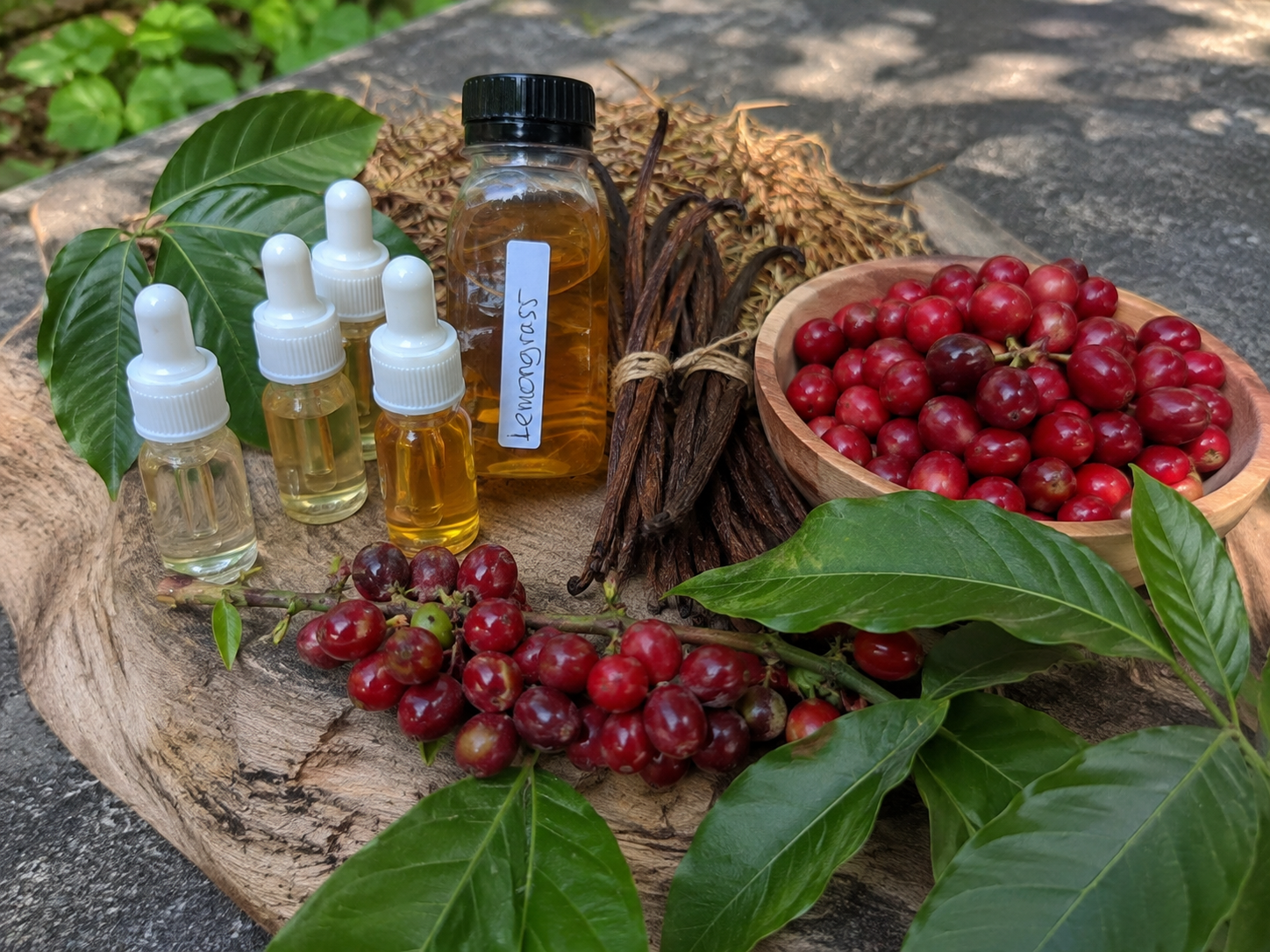
    Cananga and vanilla round out the portfolio on the fragrance and food side. Cananga flowers, or Cananga odorata, grown in Besitang, Langkat Regency, have a strong, sweet, warm and slightly woody floral aroma — the raw material for cananga oil sought by the fragrance industry. Vanilla, or Vanilla planifolia, goes through a curing process that turns its green pods dark brown, yielding a sweet, creamy, warm and complex aroma that is fought over by the bakery, confectionery, beverage and premium fragrance industries.

    Perhaps the most unexpected item on this list is benzoin, an aromatic resin from trees of the Styrax genus that grow in the forests of Tapanuli, North Sumatra. Several varieties are known there, from Toba benzoin and bulu (hair) benzoin to durame benzoin. Once dried and sorted, the resin carries a balsamic, sweet, warm, woody aroma with a hint of smokiness when burned. Besides its use as incense, benzoin also has a long history as a fragrance and aromatic-extraction ingredient — a commodity that extends PT BAS’s portfolio into non-timber forest products.

    Ultimately, these eight commodities reflect a strategy that does not rely on a single type of product. Essential oils, coffee, kitchen spices and non-timber forest products each have very different market characters, but they all rest on the same foundation: clear provenance, consistently maintained quality, and a traceable supply relationship.

    Source: Compiled from PT Bentang Alam Sumatera’s product mapping documents and the PT Bentang Alam Sumatera 2026 profile.

  • Tracing the North Sumatra-Aceh Patchouli Oil Shipment to London, Flagged Off by the Governor Himself

    Tracing the North Sumatra-Aceh Patchouli Oil Shipment to London, Flagged Off by the Governor Himself

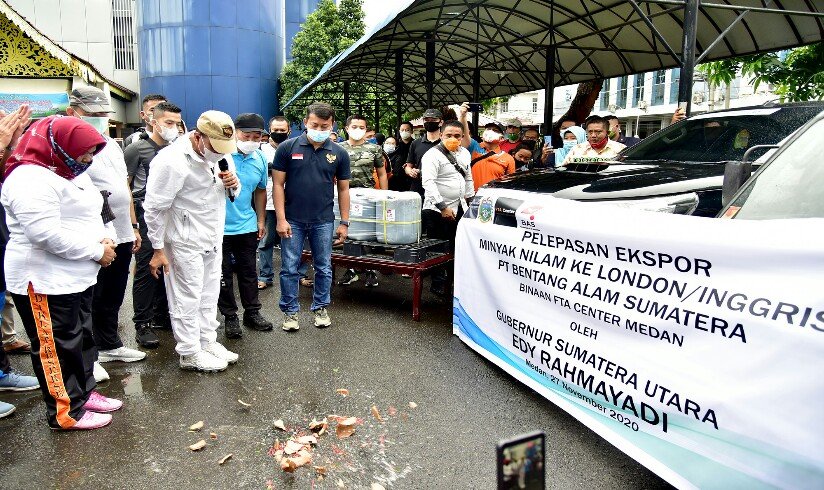
    In late November 2020, as the Covid-19 pandemic still gripped much of the business sector, the courtyard of the North Sumatra Industry and Trade Office on Jalan Putri Hijau in Medan witnessed an unusual send-off. On Friday, November 27, 2020, North Sumatra Governor Edy Rahmayadi flagged off a shipment of 600 kilograms of patchouli oil bound for London, England, the work of PT Bentang Alam Sumatera (PT BAS), an essential oil exporter based in Medan Selayang.

    The moment coincided with the handover of productive economic stimulus assistance for small businesses and farming enterprises. Governor Edy appeared upbeat. “I hope we can send off many more exports like this. It’s a symbol of our people’s prosperity,” he said, adding that he hoped such export activity would keep growing because it opens up an additional channel for local products and enterprises.

    For PT BAS, the shipment to London was more than a ceremonial send-off. A long process lay behind it: oil sourced from a network of farmers in the mountains of Sumatra had to go through collection, drying, distillation and packaging before it could meet the standards of buyers in Europe.

    Panut Hadisiswoyo, who served as president director of PT BAS at the time, said patchouli oil from North Sumatra and Aceh was among the best in quality. “Patchouli oil is a raw material used by cosmetics and perfume companies,” he said, adding that the company’s exports at the time were aimed solely at the British market, with production capacity of around 1.5 tons of patchouli oil per year.

    That claim about the quality of Aceh and North Sumatra patchouli was not just one-sided promotion. Years later, Irdika Mansur, chairman of the Indonesian Essential Oil Council, made a similar point at an international forum on patchouli and essential oils in Banda Aceh. “Aceh is a source of the best-quality patchouli oil in the world,” he said, describing Indonesia’s westernmost province as an area highly suited to patchouli cultivation.

    Indonesia’s position on the world patchouli map is no small matter. Data from the Directorate General of Plantations at the Ministry of Agriculture, widely cited by the media, shows Indonesia controls around 95% of the global patchouli oil market, with export volumes estimated at 1,200 to 1,500 tons a year to countries including Switzerland, Britain, Singapore, Spain and France. The commodity’s value depends heavily on its patchouli alcohol content and purity level, which makes quality control a critical matter starting from the moment raw material is still in farmers’ hands.

    Part of the patchouli in PT BAS’s network comes from Blangkejeren, Gayo Lues, in Aceh. After harvesting and drying, the leaves and stems are distilled into patchouli oil, then packed into jerry cans or drums before being shipped through logistics channels to their destination countries. In the perfume industry, patchouli oil is known as a base note that helps anchor and extend a fragrance’s character — a woody, earthy, warm scent favored by perfume houses, cosmetics makers and the personal care industry alike.

    In the end, the 2020 export to London illustrated a route connecting small plots in the mountains of Gayo Lues with buyers on the other side of the world. For PT BAS, that experience became a foundation for further expanding its patchouli network, along with its other essential oil and agribusiness commodities.

    Source: Compiled from reporting by Tobapos.co (November 28, 2020), Directorate General of Plantations, Ministry of Agriculture data as cited by GoodNewsFromIndonesia.id, a statement from the Indonesian Essential Oil Council as cited by ANTARA News, and the PT Bentang Alam Sumatera 2026 profile.

  • Eight Years On, PT Bentang Alam Sumatera Weaves an Essential Oil Economy From Aceh to West Sumatra

    Eight Years On, PT Bentang Alam Sumatera Weaves an Essential Oil Economy From Aceh to West Sumatra

    From a modest office in the Padang Bulan area of Medan, a team of seven runs a business whose reach spans three provinces and extends into the export market for essential oils. PT Bentang Alam Sumatera (PT BAS) was founded on January 14, 2018, building a company around aromatic commodities used by the perfume, cosmetics, personal care and aromatherapy industries.

    The PT BAS name may not be widely known among the public in North Sumatra. But for patchouli farmers in Blangkejeren and Gayo Lues, or citronella and cananga farmers in Besitang, the company is the partner that takes in their harvests and connects them to buyers far beyond their own villages.

    PT BAS’s story began with an ambition to build an essential oil market while also becoming a producer of agribusiness commodities, particularly in Aceh and across Sumatra. On paper, its mission is simple: to produce essential oils productively and sustainably. On the ground, that mission has gone hand in hand with efforts to build the capacity of farmers and farming groups and make better use of local resources, all while opening up market opportunities at home and abroad.

    The company’s structure is small, but the division of labor is clear. Panut Hadisiswoyo is the founder and CEO, Muhammad Jamil serves as director, Mustaqim, S.Hut., M.Si. handles production and partnerships, while M. Irfany serves as agroforestry specialist. That lineup shows that PT BAS’s work does not stop at the trading desk — it reaches directly into land management further upstream.

    On paper, though, PT BAS is registered as a “micro enterprise.” Its legal status is recorded under the Risk-Based Business Licensing system through a Business Identification Number (NIB) first issued in November 2018. That micro-enterprise status sits somewhat at odds with the fact that the company already runs export operations and holds an Importer Identification Number attached to its NIB.

    Its business license also covers far more than trading essential oils alone. It includes plantations for aromatic and refreshment crops, trade in agricultural and forestry products, wholesale trade in coffee, tea and cocoa, agarwood cultivation, waste remediation and management, and even research and development in the natural sciences. In other words, there is still plenty of room for the company to diversify further down the road.

    What sets PT BAS’s business model apart is how it builds its supply chain. Rather than controlling land on a large scale, the company relies on a network of partner farmers across Aceh, North Sumatra and West Sumatra. Supply is managed in a structured way, with a number of nature-based model sites developed in North Sumatra and Aceh. With an in-house team of only seven, PT BAS works alongside local stakeholders to build community capacity, especially among essential oil farmers, because long-term relationships and trust are the main capital for a small company with such a scattered network of suppliers.

    That network is what shapes PT BAS’s portfolio: patchouli, Arabica coffee, Robusta coffee, citronella oil, lemongrass, cananga, vanilla and benzoin resin. The eight commodities bring together essential oils, coffee, spices and non-timber forest products under a single supply chain.

    PT BAS’s journey from a micro enterprise in Medan Selayang to an export supply chain shows how a small team can build a business footprint far larger than its size, through partnerships, local resource management and a focus on value-added commodities.

    Source: Compiled from the PT Bentang Alam Sumatera 2026 profile and Risk-Based Business Licensing (NIB) documents issued through the OSS system.

  • Traceable Sourcing Is Becoming the Price of Entry in Global Fragrance and Coffee Markets

    Traceable Sourcing Is Becoming the Price of Entry in Global Fragrance and Coffee Markets

    In the global perfume and coffee industries, quality and price are no longer the only currencies that matter. Buyers increasingly want to know exactly where a raw material came from, who grew it, and how it reached the still or the roaster. That ability — commonly called traceability — is quietly becoming a new condition for entry into global fragrance and coffee supply chains, a shift now reaching even small, farmer-linked exporters on the Indonesian island of Sumatra, such as PT Bentang Alam Sumatera (PT BAS).

    The global patchouli oil market — the base note behind countless perfumes, and the commodity most closely tied to PT BAS — is projected to grow at a compound annual rate of about 4.2% between 2026 and 2035, according to market research firm IndexBox. Indonesia alone is estimated to supply more than 70% of the world’s patchouli oil, making the country the gravitational center of the industry. But that growth is not only about volume: the perfumery and fragrance segment, which absorbs roughly a third of global patchouli demand, is increasingly shaped by the procurement strategies of major fragrance houses actively seeking sustainable, traceable supply.

    Fragrance giants such as Givaudan, Firmenich, IFF, Symrise, Mane, and Robertet — among the world’s largest patchouli buyers — are said to be leading that push. On the production side, Indonesia’s own major players are adapting: PT Indesso Aroma, one of the world’s largest patchouli oil producers, has built its sourcing model around three pillars — traceability, environmental stewardship, and social empowerment. It is a framework not unlike the farmer-partnership model PT BAS has run on a far smaller scale across Aceh, North Sumatra, and West Sumatra.

    A similar shift is unfolding around coffee, one of PT BAS’s eight commodities. The European Union’s Deforestation Regulation (EUDR) requires seven forest-risk commodities, including coffee, to come with precise plot-level geolocation data and proof that the land was not deforested after late 2020, before entering the EU market. After two earlier postponements, the rule is now set to take effect on December 30, 2026, for large and medium operators, and June 30, 2027, for micro and small enterprises, according to reporting by Tempo.co in August 2026.

    For the small farmers scattered across Sumatra’s highlands who grow both coffee and essential-oil crops, that is no small ask. Most of the world’s coffee — Indonesia’s included — still moves through layered networks of local collectors before reaching an exporter, meaning origin data often gets lost along the way. Research from the Economic Policy Research Centre has found that Indonesian smallholder coffee farmers already contend with stagnating yields and limited access to credit, even before the added cost of mapping farms and documenting supply chains to meet new traceability standards.

    That is precisely where PT BAS’s farmer-partnership model becomes relevant. The company’s documented operations already include farmer group meetings, on-site weighing of harvests, and distillation that can be traced back to specific growing areas such as Blangkejeren in Gayo Lues, Aceh. That kind of direct relationship with growers is harder to build overnight than a certificate is to print — though turning it into the formal, geolocation-ready documentation international buyers now expect remains a real task for a company whose internal team numbers just seven people.

    For a small exporter, traceability can cut either way: a new cost if compliance requirements outpace its scale, or a competitive edge if a clear, verifiable origin story becomes a selling point to premium buyers. As long as the market keeps moving in that direction, companies that already have direct ties to the farmers in their supply chain start from a stronger position than most — a foundation grown in the field, not just written on paper.

    Source: Compiled from IndexBox’s “Patchouli Oil Market Forecast 2026-2035,” a Perfumer & Flavorist report on PT Indesso Aroma’s sourcing model, August 2026 reporting by Tempo.co on EUDR implementation for Indonesian coffee, research from the Economic Policy Research Centre on the EUDR’s impact on smallholder coffee farmers, and the PT Bentang Alam Sumatera 2026 company profile.